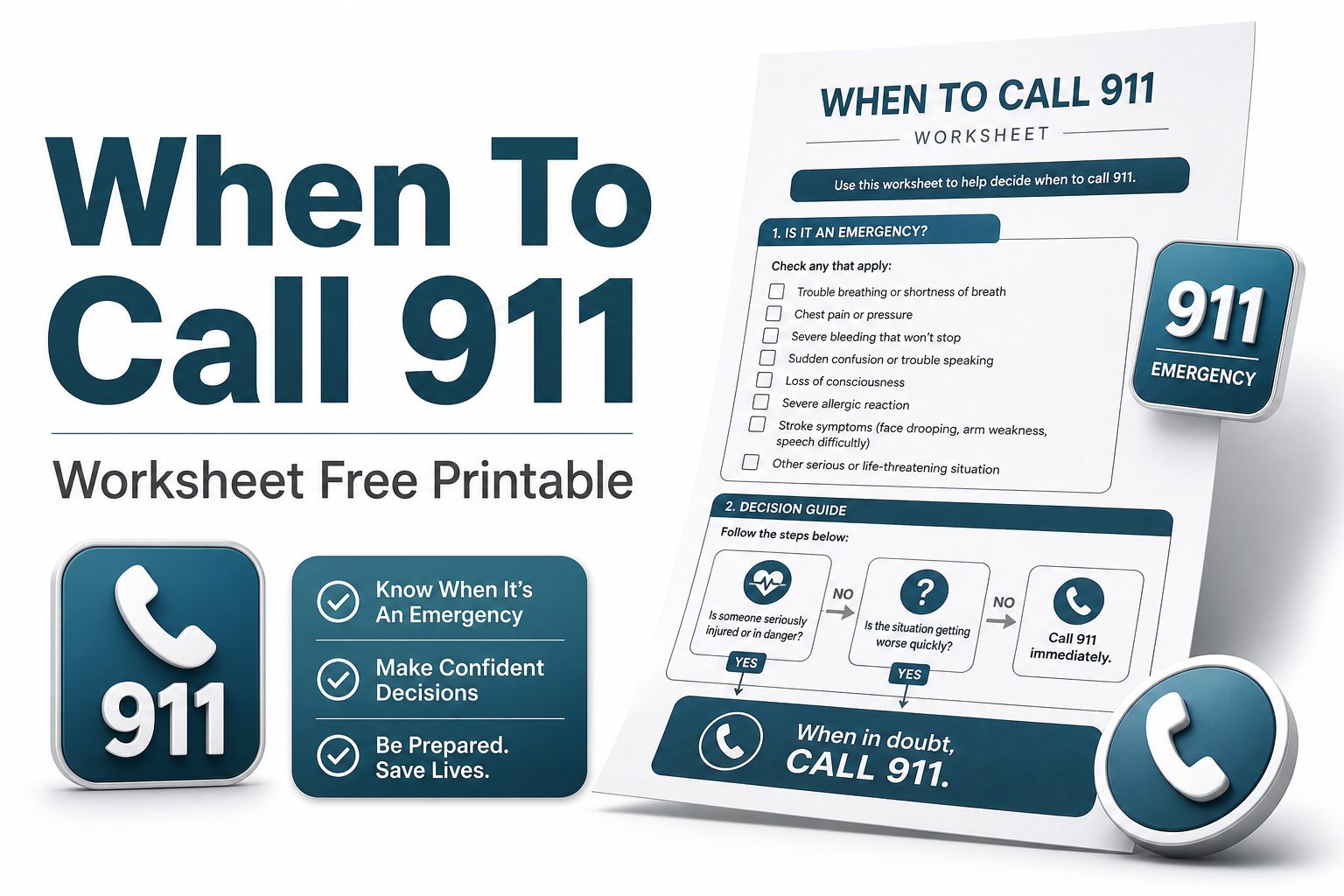
Teaching children how to react in an emergency is one of those lessons adults hope they never need, yet it can make a real difference when seconds matter. A when to call 911 worksheet free printable gives kids a simple, visual way to practice deciding what is serious, what is not, and what information they should share with a dispatcher.
The goal is not to make children fearful. It is to help them feel prepared. With the right worksheet, parents, teachers, homeschool families, and caregivers can turn a serious safety topic into calm, age-appropriate practice. Children learn that 911 is for real emergencies, such as fire, serious injury, danger, or someone who cannot wake up. They also learn that some problems need a trusted adult instead. That distinction is the heart of good emergency education.
Why Kids Need 911 Safety Practice
Children often know that 911 is an emergency number before they fully know what an emergency means. A worksheet helps connect the number to real-life situations, such as smoke in the house, a car accident, or an adult who suddenly cannot speak or breathe normally.
Without practice, children may freeze, call at the wrong time, or avoid calling when help is truly needed. Short scenario-based activities build confidence by giving kids clear choices. They also help adults spot misunderstandings before a real emergency happens.
What a 911 Worksheet Should Teach
A strong 911 worksheet teaches more than dialing three numbers. It should show children how to recognize danger, stay calm, give their location, answer simple questions, and remain on the phone until the dispatcher says it is okay to hang up.
The worksheet should also teach when not to call 911. Lost toys, boredom, minor arguments, or needing homework help are not emergencies. Kids need those examples because they make the difference between responsible action and accidental misuse of emergency services.
Key skills to include in a printable 911 worksheet:
- Recognizing fire, injury, medical danger, and unsafe situations
- Knowing the difference between emergencies and everyday problems
- Practicing a home address and phone number
- Learning to say what happened clearly
- Staying on the phone with the dispatcher
- Asking a trusted adult for help when 911 is not needed
- Avoiding prank calls or test calls without adult permission
Best Ages for Using a 911 Worksheet
Many preschool and kindergarten children can begin learning that 911 is used only for emergencies. At this age, worksheets should use pictures, simple words, and matching activities. The focus should be on safe choices rather than detailed emergency procedures.
Older children can handle more realistic scenarios and role-play prompts. First through third grade students may practice reading short situations and deciding whether to call 911, call a parent, tell a teacher, or move away from danger.
Making the Lesson Calm and Age Appropriate
Children do not need frightening stories to learn emergency safety. Clear examples work better than dramatic warnings. A worksheet should use everyday language and avoid graphic descriptions, especially for younger kids who may become anxious.
Adults can set the tone by explaining that emergency workers are helpers. The lesson should feel practical, not scary. When children understand that 911 connects them to trained adults, they are more likely to stay calm and cooperate if they ever need help.
Helpful teaching tips for parents and teachers:
- Start with simple examples before harder scenarios
- Practice saying the home address out loud
- Keep the tone calm and matter-of-fact
- Use role-play after the worksheet is finished
- Review the worksheet every few months
- Post emergency information where children can see it
- Teach children not to play with old phones that can still dial 911
Emergency Situations Kids Should Recognize
A good worksheet should include clear examples of true emergencies. Fire, heavy smoke, a serious fall, a car crash, someone choking, or a person who will not wake up are situations where calling 911 may be necessary.
Children should also learn that danger from another person can be an emergency. If someone is trying to break into the home, threatening harm, or making them feel unsafe, they should get away if possible and call 911 from a safe place.
Non-Emergency Situations Kids Should Not Call About
Just as important, children need to know what 911 is not for. A worksheet might show examples such as a scraped knee, a missing shoe, a pet hiding under the bed, or a sibling refusing to share a toy.
These situations still matter to children, so adults should not dismiss them. Instead, explain that small problems need a parent, teacher, babysitter, neighbor, or another trusted adult. That keeps the lesson respectful while protecting emergency lines for real crises.
Emergency vs Non-Emergency Comparison
Emergency situation | Better action
Smoke or flames in the house | Get out and call 911
Someone cannot wake up | Call 911 and answer questions
A small paper cut | Tell an adult and clean it
A toy is missing | Ask an adult for help
A stranger is trying to enter the home | Move to safety and call 911
A friend will not share | Talk to a trusted adult
Someone is choking and cannot breathe | Call 911 right away
The power goes out with no danger | Tell an adult
What to Include in a Free Printable Worksheet
A useful free printable should include a mix of activities, not just a list of rules. Children remember better when they sort, circle, match, trace, draw, and say answers aloud. Variety keeps the lesson active and easier to repeat later.
For younger kids, picture cards and yes-or-no choices work well. For older kids, short written scenarios help build judgment. A printable worksheet can also include a small emergency information box for address, caregiver names, and phone numbers.
Printable Scenario Activities That Work
Scenario activities are often the most valuable part of a 911 worksheet. They ask children to decide what they would do in a specific situation. This helps them move from memorizing a number to thinking through safe actions.
Keep scenarios short and realistic. For example, “You see smoke coming from the kitchen” is easier to process than a long story. Children should be able to circle “Call 911,” “Tell an adult,” or “Not an emergency” without confusion.
Worksheet activity ideas:
- Circle the emergencies
- Cross out non-emergency examples
- Match helpers to situations
- Trace 9-1-1
- Fill in address and phone number
- Sort picture cards into emergency and not emergency
- Draw a safe meeting place outside the home
- Practice what to say to a dispatcher
Teaching Kids What to Say on a 911 Call
Children need to know that the dispatcher will ask questions. A worksheet can include a simple script: “My name is ___. I need help. I am at ___. The emergency is ___.” Repeating this format makes the call feel less confusing.
Location is especially important. Kids should practice saying their full address, including apartment number if needed. If they are at school, a park, or a neighbor’s house, they should describe where they are as clearly as possible.
Why Staying on the Phone Matters
Some children may think they should hang up after saying there is an emergency. A worksheet should clearly teach them to stay on the line. The dispatcher may need more information or may give instructions until help arrives.
This lesson also helps with accidental calls. If a child dials 911 by mistake, they should not hang up. They should tell the call-taker it was an accident so emergency workers know there is no crisis.
Simple 911 call practice script:
- “My name is Ava.”
- “I need help.”
- “I am at 24 Maple Street, Apartment 2.”
- “My grandma fell and is not answering me.”
- “I am staying on the phone.”
- “I will answer your questions.”
- “I will not hang up until you tell me.”
How Parents Can Use the Worksheet at Home
At home, the worksheet works best as part of a short family safety talk. Sit with your child, read each situation together, and ask them why they chose an answer. Their explanation matters as much as the answer itself.
After the worksheet, walk through the home and point out safety details. Show exits, smoke alarms, the meeting place outside, and where emergency contact information is posted. These real-world connections make the printable more useful.
How Teachers Can Use the Worksheet in Class
Teachers can use a when to call 911 lesson during health, safety, community helpers, or life skills units. The worksheet can be completed individually, in small groups, or as a guided class discussion.
Classroom use should include clear boundaries. Children should know this is practice and that they should never dial 911 during pretend play. Teachers can add role-play using toy phones, paper phones, or spoken scripts instead of real devices.
Classroom lesson plan format:
- Warm-up: Name people who help in emergencies
- Mini lesson: Explain when 911 is used
- Worksheet: Sort emergency and non-emergency situations
- Discussion: Share answers and reasons
- Practice: Say name, address, and emergency clearly
- Review: Repeat the rule that 911 is only for real emergencies
- Take-home: Send family emergency information practice home
Adding Address Practice to the Printable
Knowing when to call is only part of the lesson. Children also need to know where help should go. A worksheet should include space for the child’s full address, city, state, and a caregiver phone number.
For privacy, classroom worksheets sent home should let families fill in address details at home. Teachers can still practice the concept by using a sample address or the school address during class activities.
Teaching Cell Phone and Landline Differences
Many children will use a mobile phone if an emergency happens. They should know how to wake the screen, use emergency call options if available, and speak clearly. Families can practice this without placing a real call.
Children should also know that old phones may still connect to emergency services. A worksheet note for parents can remind adults to supervise unused phones and avoid giving children disconnected phones as toys.
Important phone safety facts:
- 911 is for real emergencies only
- Children should not practice by calling 911
- Accidental calls should be explained to the dispatcher
- Calling is best when the child can speak
- Text-to-911 may exist in some areas, but voice calls are usually preferred
- Adults should teach kids how their specific phone works
- Emergency information should be easy to find at home
Using Visuals for Early Learners
Young children often learn faster from pictures than from written directions. A printable for preschool or kindergarten can use images of fire, an injured person, a police officer, a firefighter, a phone, and a trusted adult.
Visuals should be clear and respectful. Avoid frightening images. Simple drawings or icons help children identify the situation without becoming overwhelmed. The goal is recognition, not fear.
Using Reading Prompts for Older Kids
Older elementary students can work through short written prompts with more nuance. They can decide whether to call 911, call a non-emergency number, tell an adult, or use a family safety plan.
These prompts are useful because real life is not always obvious. A child may need to decide whether a situation is urgent, whether they are safe, and who can help fastest. Written practice strengthens that judgment.
Sample worksheet prompts:
- You smell smoke and hear the smoke alarm
- Your brother falls and cannot stand up
- Your cat spills water on the floor
- A stranger is trying to open the front door
- Your friend gets a small scratch at recess
- An adult suddenly cannot talk clearly
- You cannot find your favorite book
- You see a car crash near your house
Pairing the Worksheet With Family Safety Plans
A worksheet is stronger when it connects to a family safety plan. Children should know where to meet outside during a fire, which neighbor is safe to ask for help, and which adults may pick them up from school.
Families can review this information during calm moments, not during a crisis. Repetition helps children remember. A printable home safety checklist can support this lesson and keep important details in one visible place.
For more practice, our kids emergency preparedness activities can help families build safety routines around fire drills, storm plans, and emergency contacts. These lessons work well alongside a 911 worksheet because they turn one safety topic into a broader preparedness habit.
Common Mistakes to Avoid
One common mistake is teaching children only to memorize 911 without teaching decision-making. Memorization matters, but children also need examples. They should know what makes something dangerous enough for emergency help.
Another mistake is making the lesson too scary. Children learn best when adults stay calm and clear. Avoid intense stories, threats, or punishment-based language. The worksheet should build confidence, not anxiety.
Mistakes to watch for:
- Skipping address practice
- Using vague examples like “bad things”
- Letting children role-play with a real phone
- Forgetting to explain accidental calls
- Teaching only fire scenarios
- Assuming one lesson is enough
- Giving too much detail to very young children
- Forgetting babysitters and grandparents in the safety plan
How Often to Review 911 Safety
Children forget details over time, especially if they do not use them. Reviewing a 911 worksheet two or three times a year is a practical habit. Families can connect the review to smoke alarm checks or seasonal safety routines.
Teachers can repeat the lesson during fire prevention week, community helper units, or back-to-school safety lessons. Short refreshers are more effective than one long lesson. The more familiar the steps feel, the easier they are to remember.
Adapting the Worksheet for Special Needs
Some children may need visual schedules, simplified language, larger print, or repeated practice. A free printable can be adapted by reducing the number of choices, adding symbols, or using real photos of home, school, and caregivers.
Children with communication differences may benefit from pointing cards or pre-written emergency phrases. The main goal remains the same: help the child get assistance in a way that matches their abilities and daily environment.
Adaptation ideas:
- Use fewer scenarios per page
- Add picture choices beside each answer
- Use large, clear fonts
- Practice with the child’s actual address card
- Add caregiver photos
- Use color coding for emergency and not emergency
- Repeat the same format each time
- Keep directions short and consistent
Making the Printable More Useful for Families
A worksheet becomes more valuable when it goes home with action steps. Add a small section for families to fill in address, emergency contacts, allergies, medical notes, and a safe meeting place. This turns the activity into a practical household resource.
Parents can place the completed page on the refrigerator, near a family command center, or inside a babysitter folder. The worksheet should be easy to read quickly, especially during stressful moments when clear information matters.
Printable Design Tips for Better Learning
Good worksheet design keeps children focused. Use enough white space, readable fonts, and simple directions. Crowded pages make it harder for young learners to understand the task and may reduce the usefulness of the activity.
Use repeated answer choices so children learn the pattern. For example, each scenario can offer “Call 911,” “Tell an adult,” and “Not an emergency.” Consistency supports independent practice and makes review easier for parents or teachers.
For related safety planning, see our printable home safety checklist. It pairs well with emergency number practice because families can review smoke alarms, exits, meeting places, and contact information at the same time.
Conclusion
Teaching children when and how to contact emergency services is a life skill that deserves calm, repeated practice. A good worksheet helps children recognize serious danger, avoid unnecessary calls, share their location, and stay on the phone with a dispatcher until help is on the way.
Parents and teachers do not need to make the lesson complicated. Clear examples, short discussions, role-play without real calls, and regular review can help children feel prepared without feeling frightened. The best materials are simple, visual, practical, and connected to the child’s real home or school environment.
A when to call 911 worksheet free printable is most effective when adults use it as a conversation tool, not just a page to complete. When children understand both the number and the responsibility behind it, they are better prepared to make a safe choice in a real emergency.
FAQ
At what age should kids learn to call 911?
Many children can begin learning about 911 around preschool age, using simple pictures and calm examples. Older children can practice more detailed scenarios, address information, and what to say during an emergency call.
Should children practice calling 911 on a real phone?
Children should not practice by placing a real 911 call. Use a toy phone, paper phone, or turned-off device for role-play. If 911 is dialed by accident, stay on the line and explain what happened.
What should a child say when calling 911
A child should say their name, location, and what is happening. They should answer the dispatcher’s questions and stay on the phone until told to hang up. Practicing a short script helps children feel prepared.
Can a 911 worksheet be used in preschool?
Yes, but it should be very simple. Preschool worksheets work best with pictures, matching, tracing 9-1-1, and basic choices like emergency or not emergency. Adults should guide the activity and explain each example.
How often should families review 911 rules?
Families should review 911 rules several times a year. Good times include the start of the school year, fire drill practice, babysitter updates, or smoke alarm checks. Repetition helps children remember under pressure.
0 Comments