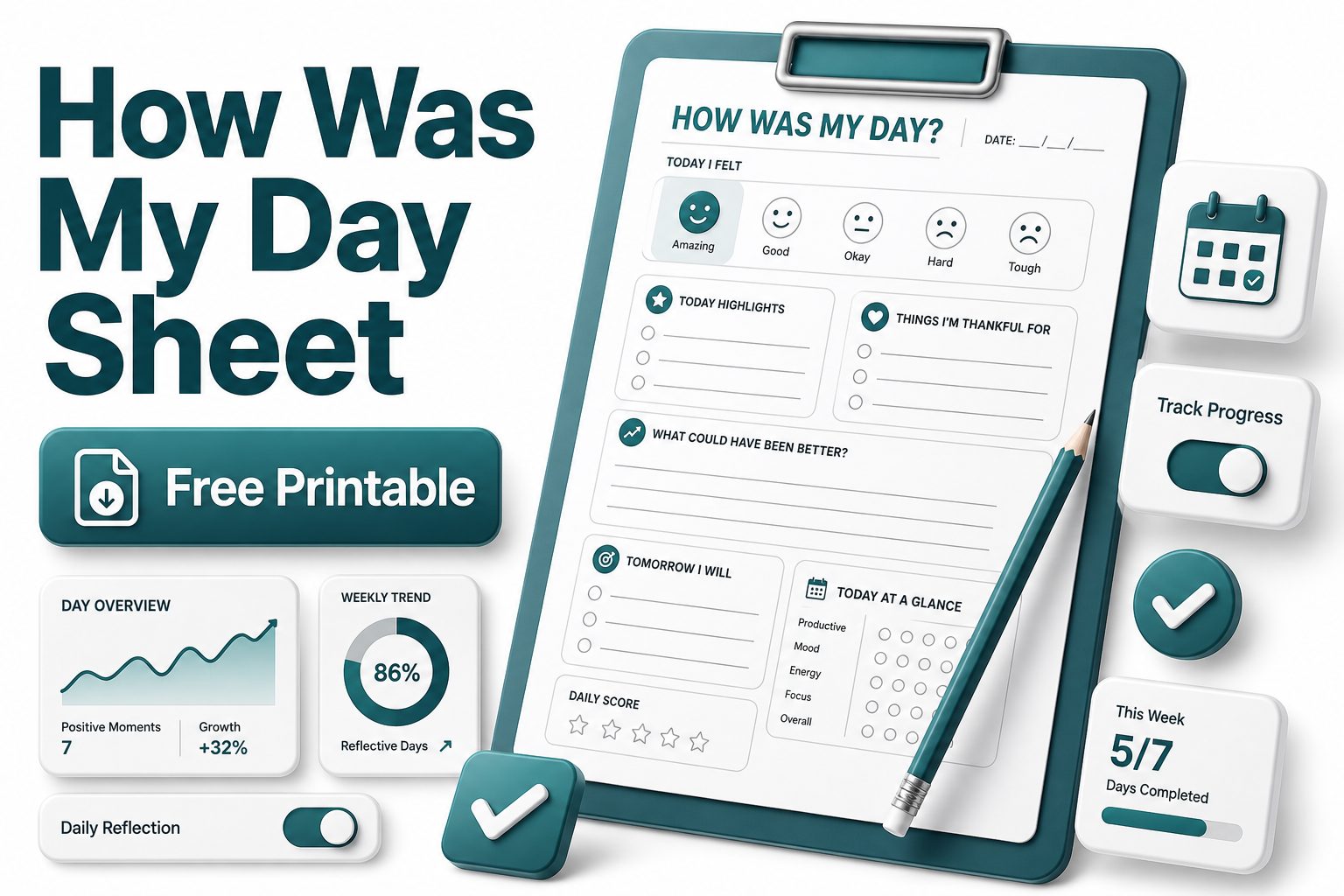
A how was my day sheet free printable is a simple tool that helps children reflect on their daily experiences in a calm, structured way. Instead of asking a broad question like “How was school,” parents and teachers can use a printed sheet with clear prompts, feelings check-ins, and space for drawing or writing. This makes it easier for kids to share what happened, how they felt, and what they may need help with.
Many children struggle to explain their day in detail, especially after a busy school schedule. A daily reflection page gives them a gentle starting point. It can support emotional awareness, communication skills, classroom routines, and parent-child connection. Whether used after school, during morning meetings, or as part of a homeschool journal, this printable can turn everyday reflection into a meaningful habit.
Why a Daily Reflection Sheet Helps Children
A daily reflection sheet gives children a simple way to process their experiences before moving on to the next activity. It helps them notice feelings, remember positive moments, and name challenges without pressure. This is especially useful for younger children who may not yet have strong verbal expression skills.
When used regularly, the sheet becomes part of a predictable routine. Children know they will have a chance to share highlights, concerns, and small wins. Parents and teachers can also spot patterns, such as repeated worries, social struggles, or activities that consistently make the child feel confident.
Best Uses for a How Was My Day Sheet
A how was my day sheet free printable works well at home, in classrooms, therapy settings, daycare centers, and homeschool routines. Parents can place it in a binder, teachers can use it as a closing activity, and caregivers can send it home as a quick communication tool.
It can also help children who are shy, tired, or easily overwhelmed after school. Instead of answering many spoken questions, they can circle a feeling, draw a moment, or write one sentence. This makes the process less stressful while still giving adults useful insight.
Key Benefits of Using a Daily Printable Sheet
- Builds emotional vocabulary through simple feelings prompts
- Encourages children to talk about school and home experiences
- Helps parents and teachers identify repeated concerns
- Supports writing, drawing, memory, and self-expression
- Creates a calm end-of-day routine
- Gives children a private way to share difficult moments
- Works well for preschool, kindergarten, elementary, and homeschool use
What to Include on the Printable Page
A strong daily sheet should be easy for children to complete without too much adult help. Useful sections include mood choices, favorite part of the day, something difficult, one thing learned, and a small drawing area. The layout should feel friendly, not like a test.
For younger children, use picture-based prompts such as happy, sad, excited, worried, or tired faces. Older children may prefer short writing lines and rating scales. The best printable balances structure with enough open space for honest, personal responses.
Simple Prompts That Encourage Honest Answers
Prompts should be specific enough to guide children but open enough to allow real expression. “One thing that made me smile” often works better than “What was good today.” A clear prompt helps children focus on a single memory instead of sorting through the entire day.
Other useful prompts include “Something I want to talk about,” “One kind thing I did,” and “Something I found hard.” These invite children to share more than surface-level answers. They also teach that every day can include both good moments and difficult ones.
Daily Sheet Prompt Ideas
Prompt Type | Example Prompt | Best For
Mood check-in | Today I felt | Emotional awareness
Positive moment | The best part was | Gratitude and memory
Challenge | Something hard was | Problem solving
Social reflection | I played or worked with | Friendship awareness
Learning prompt | I learned about | School connection
Follow-up need | I want help with | Parent or teacher support
How Parents Can Use the Sheet at Home
Parents can use the sheet as a relaxed after-school routine rather than a formal assignment. A good time is after snack, quiet play, or a short rest. Children often open up more when they are not rushed or expected to explain everything immediately.
Keep completed pages in a folder or binder. Over time, these pages become a record of growth, changing interests, friendships, worries, and achievements. They can also help during parent-teacher conferences when you want concrete examples of your child’s school experience.
How Teachers Can Use It in the Classroom
Teachers can use a daily reflection page during dismissal, morning work, or weekly wrap-up time. It gives students a calm transition and helps them practice self-awareness. For large classes, a quick check-in format is easier to manage than individual conversations every day.
The sheet can also support classroom management. If several students mention the same difficulty, such as recess conflict or confusion about a lesson, the teacher gains helpful feedback. This turns student reflection into a practical tool for improving classroom routines.
Home and Classroom Checklist
- Choose a consistent time of day
- Keep the sheet short and age-appropriate
- Offer drawing options for younger children
- Avoid correcting every spelling mistake
- Read responses without judgment
- Follow up privately on serious concerns
- Save completed sheets in a folder
- Use patterns to guide conversations and support
Printable Design Tips for Younger Kids
For preschool and kindergarten children, visual design matters. Large icons, simple faces, wide writing lines, and open drawing boxes make the sheet easier to use. Too many sections can overwhelm young learners, so three to five prompts are usually enough.
Use simple wording such as “I felt,” “I liked,” and “I need help with.” Children at this age may respond with drawings, single words, or circled pictures. That is still valuable reflection. The goal is communication, not perfect spelling or complete sentences.
Printable Design Tips for Older Children
Elementary-age children can handle more detailed prompts. They may enjoy rating their day, writing a short sentence, or choosing from a wider range of emotions. A slightly more mature layout helps them feel respected and keeps the activity from feeling too babyish.
For older kids, include prompts about effort, kindness, friendship, and goals. You might add “One choice I am proud of” or “Tomorrow I want to try.” These questions encourage responsibility and growth without turning the sheet into a lecture.
Age-Based Printable Ideas
Preschool: Use smiley faces, color-in mood boxes, and drawing spaces.
Kindergarten: Add simple sentence starters and large handwriting lines.
Grades 1-2: Include feelings, favorite activity, and one challenge.
Grades 3-5: Use short written reflections, goal prompts, and effort ratings.
Homeschool: Add subject reflections, reading notes, and daily wins.
How the Sheet Supports Emotional Skills
Children learn emotional awareness through repetition and language. When they circle “frustrated,” “proud,” or “nervous,” they begin connecting words to body feelings and daily events. This makes future conversations easier because they have practiced naming emotions in a low-pressure way.
A reflection sheet also shows children that feelings change from day to day. One hard afternoon does not define the whole week. Seeing different moods on paper can help kids recognize patterns and learn that emotions are normal, manageable, and worth discussing.
Using the Sheet for Better Parent-Child Conversations
Many parents ask children about their day and receive one-word answers. A completed sheet gives the conversation a starting point. Instead of asking broad questions, you can say, “I noticed you wrote that lunch was hard. Do you want to tell me more?”
This approach feels less like an interview. Children can lead the conversation based on what they already shared. Parents should stay calm, listen first, and avoid turning every response into advice. The sheet works best when children trust that honesty will be met with patience.
Tips for Better Conversations
- Start with one detail from the page
- Ask calm follow-up questions
- Let children skip topics sometimes
- Notice positive moments, not only problems
- Avoid rushing into solutions
- Thank your child for sharing
- Keep the tone warm and casual
- Use the sheet as a bridge, not a script
Making the Printable Part of a Routine
A printable reflection sheet works best when it becomes predictable. Children do not need to complete it every single day, but consistency helps. Some families use it Monday through Friday, while others save it for school nights or days with big transitions.
Keep supplies easy to reach. A clipboard, pencil cup, crayons, and folder can make the routine smoother. If the sheet feels like a natural part of the afternoon or classroom schedule, children are more likely to participate without resistance.
Ways to Personalize the Sheet
Personalization makes the printable more meaningful. Add the child’s name, a favorite color, or a small section for stickers. Teachers might include the classroom theme, while parents may add a weekly goal or space for a short note back to the child.
You can also rotate prompts to prevent boredom. One day might focus on kindness, another on learning, and another on feelings. If you offer printables on your website, consider linking to related resources such as [Internal Link: Kids Daily Routine Printable] or [Internal Link: Feelings Chart for Children].
Personalization Ideas
- Add a name line at the top
- Include a weather or mood tracker
- Offer space for a drawing
- Add a parent or teacher response box
- Use seasonal borders sparingly
- Create versions for different ages
- Include a weekly reflection option
- Make black-and-white copies for easy printing
Common Mistakes to Avoid
One common mistake is making the sheet too long. Children may lose interest if they see too many prompts or tiny writing spaces. A reflection printable should feel quick and approachable. If it takes more than five to ten minutes, it may become a chore.
Another mistake is using the sheet to inspect or correct every detail. If adults focus only on handwriting, grammar, or negative answers, children may stop being honest. Treat the page as a communication tool first. Skill practice can happen naturally over time.
Printing and Organization Tips
For regular use, print several copies at once and store them in a folder, binder, or tray. Black-and-white designs are often the most practical because they save ink and can be colored by children. A clean layout usually prints better than a design with heavy backgrounds.
If you prefer less paper, laminate one copy and use a dry-erase marker. This works well for quick mood check-ins, although it does not preserve long-term responses. For memory keeping or progress tracking, paper copies are still more useful.
Printable Setup Comparison
Option | Best Use | Main Advantage
Single daily page | Home after school | Easy personal reflection
Weekly sheet | Busy families | Less printing
Laminated page | Quick check-ins | Reusable format
Binder system | Long-term tracking | Shows patterns over time
Classroom stack | Teacher routines | Simple group activity
Using the Sheet for Homeschool Reflection
Homeschool families can adapt the sheet beyond emotional check-ins. A daily page can include favorite subject, hardest task, reading progress, outdoor activity, and one question the child still has. This gives parents a simple record of both learning and mood.
It can also help children take ownership of their education. When they write what felt easy or difficult, they learn to evaluate their own progress. This habit supports independence and helps parents adjust lessons without relying only on worksheets or test scores.
How to Make the Sheet Feel Natural
Children respond better when reflection feels normal, not forced. Adults can model the habit by sharing one sentence about their own day. For example, a parent might say, “My best part was lunch outside, and one hard part was a busy meeting.”
Keep the mood relaxed. Some days children will write a lot, and other days they may circle one feeling and draw a quick picture. That is fine. The purpose is to build a steady habit of noticing, naming, and sharing daily experiences.
Practical Ways to Encourage Participation
- Let children choose pencils, crayons, or markers
- Keep the sheet short
- Offer drawing as an alternative to writing
- Use it at the same time each day
- Read responses privately when needed
- Celebrate effort without overdoing praise
- Change prompts when interest drops
- Let older children help choose categories
Adapting the Sheet for Sensitive Children
Some children need extra privacy when reflecting on their day. If a child feels exposed, allow them to fold the sheet, place it in a folder, or choose which section to discuss. Respecting privacy helps protect trust and encourages more honest responses later.
Sensitive children may also prefer gentle wording. Instead of “What went wrong,” use “Something tricky today was.” Small wording changes matter. They reduce shame and help children talk about challenges as normal parts of life rather than failures.
Using the Sheet for Behavior and Social Growth
A daily reflection page can support behavior growth without feeling punitive. Prompts such as “One good choice I made” or “One thing I can try tomorrow” help children think about actions and outcomes. This is more constructive than focusing only on mistakes.
For social development, include prompts about kindness, teamwork, and friendship. Children can write who they helped, who helped them, or whether they felt included. These small reflections can reveal important social patterns that adults might otherwise miss.
Behavior and Social Prompt Examples
- One kind thing I did today
- Someone who helped me today
- A choice I am proud of
- Something I want to do better tomorrow
- A time I used patience
- Someone I enjoyed spending time with
- A problem I solved
- A feeling I handled well
Conclusion
A daily reflection printable is a small resource with a lasting impact. It helps children slow down, name their feelings, remember meaningful moments, and share concerns in a way that feels manageable. For parents, teachers, and homeschool families, it creates a reliable window into a child’s day without turning conversation into pressure.
The best versions are simple, age-appropriate, and easy to use consistently. Whether your child draws one picture or writes several sentences, the habit itself builds emotional awareness and communication. A how was my day sheet free printable can become part of a calm routine that supports connection, confidence, and healthier conversations after busy days.
FAQ
What age is a daily reflection sheet best for?
A daily reflection sheet works well for preschool through elementary school. Younger children may use pictures and mood faces, while older children can write short responses about feelings, friendships, learning, and daily challenges.
How often should children use the sheet?
Most children benefit from using it three to five times per week. Daily use is helpful when it feels relaxed, but it should not become another stressful task after school or lessons.
Can teachers send the sheet home?
Yes, teachers can use it as a simple home-school communication tool. A short completed sheet helps families see how the day went and gives parents a useful starting point for conversation.
Should parents correct spelling on the sheet?
It is better to focus on communication first. Correcting every spelling mistake can make children hesitant to write. Save formal writing practice for another time unless the child asks for help.
What makes a good printable layout?
A good layout is clear, uncluttered, and age-appropriate. It should include simple prompts, enough writing or drawing space, and feelings options that help children respond without becoming overwhelmed.
0 Comments