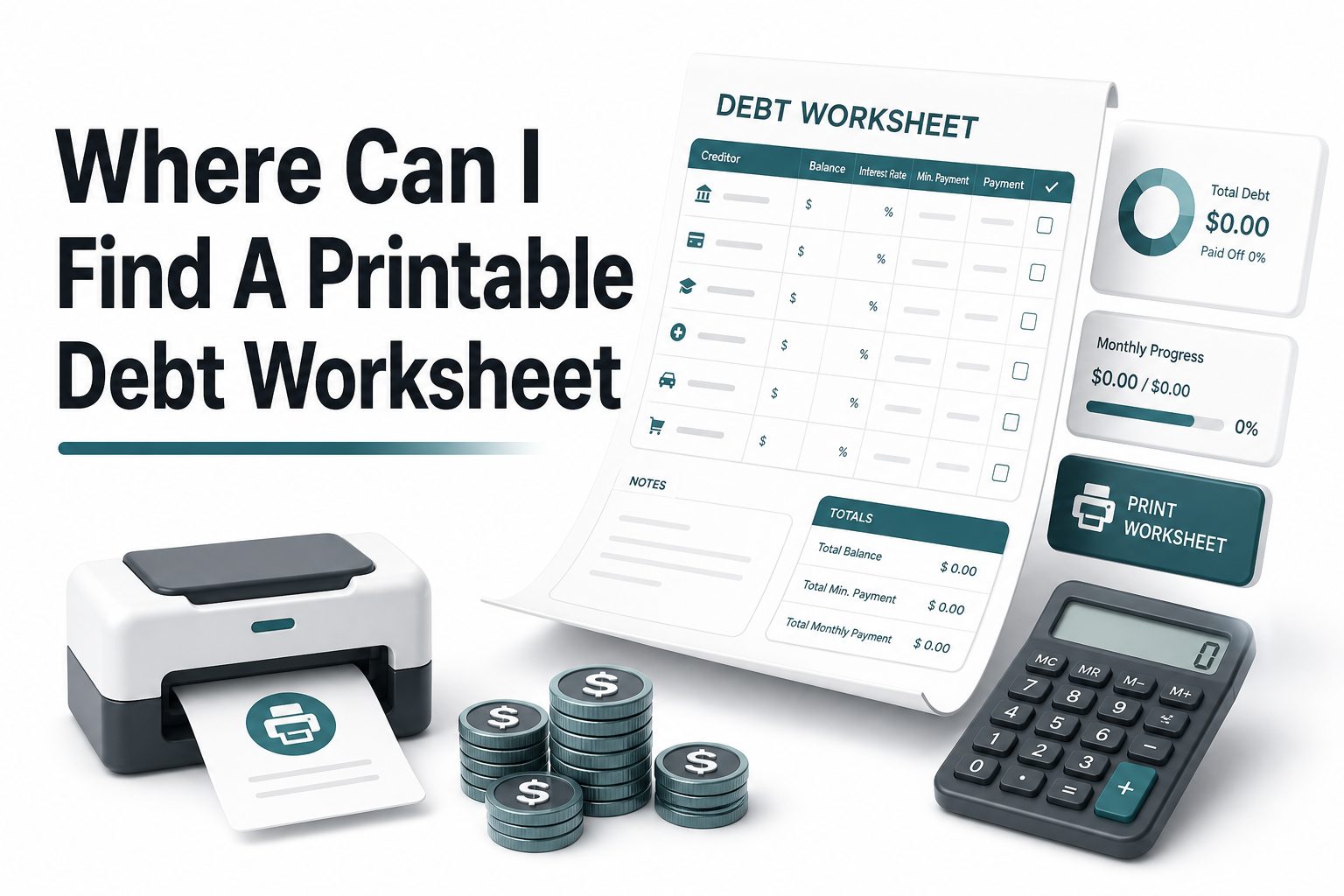
If you have several credit cards, loans, medical bills, or overdue balances, it can be hard to know where your money should go first. A printable debt worksheet gives you one simple place to list what you owe, compare interest rates, track payments, and build a payoff plan you can actually follow.
Many people search for where can i find a printable debt worksheet because they want something practical, not another finance app or complicated spreadsheet. A good worksheet helps you see the full picture without logging into five accounts or guessing at numbers. Whether you are starting a debt snowball, trying a debt avalanche, or just organizing bills before payday, the right printable form can turn stress into a clear next step.
Best Places to Find Printable Debt Worksheets
You can find printable debt worksheets from government agencies, nonprofit financial education sites, credit counseling organizations, personal finance blogs, and budgeting template libraries. The most reliable options are usually free, easy to download, and designed to help you list balances, payment dates, interest rates, and payoff goals.
Start with trusted sources such as the Consumer Financial Protection Bureau, consumer.gov, and nonprofit credit counseling agencies. These worksheets are usually practical and plain, which is a benefit when you need accuracy more than decoration. Printable PDF versions are especially helpful if you prefer writing by hand.
What a Debt Worksheet Should Include
A useful debt worksheet should include the creditor name, total balance, minimum payment, interest rate, due date, payment status, and notes. These fields help you compare debts side by side instead of treating every bill as equally urgent or equally expensive.
The best worksheets also include a payoff strategy section. This might let you rank debts by balance, interest rate, or emotional priority. When your worksheet connects the numbers to a specific plan, it becomes more than a list. It becomes a monthly decision tool.
Useful features to look for in a printable debt worksheet:
- Space for every creditor or lender
- Current balance and original balance columns
- Minimum payment field
- Interest rate field
- Monthly payment tracking
- Due date reminders
- Payoff priority ranking
- Extra payment notes
- Total debt summary
- Goal date or target payoff month
Government Websites With Printable Debt Tools
Government financial education websites are good starting points because their resources are usually free and written for everyday consumers. The Consumer Financial Protection Bureau offers printable tools for debt logs, debt action plans, bill tracking, credit reports, and repayment decisions.
Consumer.gov also provides simple budgeting worksheets that can support your debt plan. While a budget worksheet is not always labeled as a debt worksheet, it helps you identify how much money is available for minimum payments, extra payments, savings, and essential expenses.
Nonprofit Credit Counseling Resources
Nonprofit credit counseling agencies often provide printable debt management worksheets, budget forms, and repayment planning tools. These are useful if your debt includes credit cards, personal loans, medical bills, collections, or accounts that are already past due.
Look for agencies connected with recognized nonprofit financial counseling networks. Their worksheets are usually designed for real counseling conversations, so they focus on accurate totals, monthly cash flow, and creditor details. That makes them more useful than overly styled templates with limited space.
Comparison Table of Debt Worksheet Sources
Source Type | Best For | Cost | What to Expect
Government websites | Reliable consumer education | Usually free | Simple PDFs, debt logs, budget tools, repayment planning worksheets
Nonprofit credit counseling sites | Serious debt organization | Usually free | Debt inventory forms, budget worksheets, creditor lists
Personal finance blogs | Printable trackers and planning pages | Free or paid | More design options, debt snowball sheets, monthly trackers
Template marketplaces | Custom layouts | Free or paid | Editable PDFs, planners, spreadsheet-style printables
Budgeting apps with print options | Hybrid digital and paper use | Free or paid | Exportable reports, printable payment summaries
Printable Debt Worksheets From Personal Finance Blogs
Personal finance blogs often offer printable debt worksheets as free downloads, email opt-ins, or low-cost planner pages. These can be helpful if you want a worksheet that looks organized, includes motivational trackers, or supports a specific payoff method like the debt snowball.
Be selective, though. A pretty worksheet is not always a useful worksheet. Before downloading, check whether it includes the fields you need. If the layout has more decorative space than tracking space, it may not help much once you start adding real numbers.
Free Printable Budgeting Libraries
Many budgeting websites keep free resource libraries with debt trackers, monthly budget forms, bill calendars, savings trackers, and payment logs. These can work well if you want several printable pages that fit together as a full household finance binder.
A debt worksheet becomes more powerful when paired with a monthly budget and bill calendar. The budget shows available money, the bill calendar prevents late payments, and the debt tracker shows progress. Together, they make your plan easier to maintain.
How to Choose the Right Printable Debt Worksheet
Choose a worksheet based on your financial situation, not just the design. If you have only two or three debts, a simple one-page tracker may be enough. If you have many accounts, choose a worksheet with plenty of rows and summary totals.
If interest charges are your biggest problem, use a worksheet that includes annual percentage rates. If missed due dates are the issue, choose one with payment dates and checkboxes. The right format should make your next action obvious every time you review it.
Simple checklist before downloading:
- Is the worksheet easy to print in black and white
- Does it have enough space for all debts
- Are interest rates included
- Are due dates included
- Can you track payments month by month
- Is there room for extra payment notes
- Does it support your payoff method
- Can you reuse it each month
- Is the source trustworthy
- Is the download free of unnecessary sign-up steps
Debt Snowball Worksheets
A debt snowball worksheet helps you list debts from smallest balance to largest balance. You pay minimums on everything, then put extra money toward the smallest debt first. Once that account is paid off, you roll that payment into the next smallest debt.
This method works well for people who need quick wins to stay motivated. The worksheet should include balance, minimum payment, extra payment, payoff date, and a paid-off checkbox. Seeing accounts disappear from the page can be a strong motivator.
Debt Avalanche Worksheets
A debt avalanche worksheet ranks debts by interest rate, usually from highest to lowest. You still pay minimums on every account, but extra money goes toward the debt with the highest interest rate first. This can reduce the total interest you pay over time.
This worksheet is best when you are comfortable following the math even if the first payoff takes longer. It should clearly show APR, balance, minimum payment, and estimated interest cost. The goal is to make the most expensive debt stand out immediately.
Printable Debt Tracker Versus Debt Payoff Worksheet
A printable debt tracker records what you owe and how your balances change over time. It is mainly used for monitoring progress. A debt payoff worksheet goes further by helping you choose a repayment order and assign extra payments.
Most people benefit from using both. The tracker keeps your records current, while the payoff worksheet guides your strategy. If you can find one printable that combines both functions, it may be easier to maintain each month.
When to Use a Budget Worksheet Instead
A budget worksheet is better when you do not yet know how much money is available for debt payments. Before building a payoff plan, you need to list income, housing, utilities, groceries, insurance, transportation, and other monthly costs.
Once you know your monthly surplus, you can decide how much to send toward debt. For more help organizing income and expenses, see [Internal Link: Monthly Budget Worksheet]. A debt plan without a budget often breaks down because it ignores real cash flow.
Key benefits of using printable worksheets:
- You can see all debts in one place
- You do not need a paid app
- Writing by hand can make numbers feel more real
- Printed pages are easy to review with a partner
- You can keep records in a binder
- Progress is visible from month to month
- Worksheets reduce missed payment confusion
- They support both simple and detailed payoff plans
How to Fill Out a Debt Worksheet Correctly
Start by gathering recent statements for every debt account. Include credit cards, personal loans, medical bills, auto loans, student loans, buy now pay later balances, collection accounts, and money owed to family or friends. Do not rely on memory if accurate numbers are available.
Write down the current balance, minimum payment, interest rate, due date, and creditor contact information. If a debt has no interest or no fixed due date, note that clearly. Complete information helps you avoid making decisions from partial numbers.
Common Mistakes to Avoid
One common mistake is leaving out small debts because they seem unimportant. Small balances still affect your monthly cash flow and may become easy early wins. Add every debt, even if the balance feels too minor to track.
Another mistake is listing debts once and never updating the worksheet. Balances change as interest is added and payments are made. Review your worksheet at least once a month so your payoff plan stays connected to your real financial situation.
Printable Worksheets for Credit Card Debt
Credit card debt worksheets should include the card issuer, balance, APR, minimum payment, credit limit, due date, and extra payment amount. Since credit card interest can be high, the APR column is especially important for choosing a payoff order.
If you carry balances on several cards, use the worksheet to compare minimum payments and available cash. You may also want to track whether a card has a promotional rate, when that rate ends, and what the regular APR will be afterward.
Printable Worksheets for Medical Debt
Medical debt worksheets should include the provider name, bill date, balance, insurance status, payment plan terms, and contact notes. Medical bills can change after insurance adjustments, so it is worth confirming the final patient responsibility before setting a payment schedule.
Use the notes section to record calls, payment agreements, financial assistance applications, and dispute details. A printable worksheet can be especially useful here because medical debt often involves several offices, different account numbers, and separate billing departments.
Tips for printing and using your worksheet:
- Print at least three copies before you start
- Use pencil if balances change often
- Keep statements with the worksheet
- Review the page on the same date each month
- Highlight high-interest debts
- Circle missed or risky due dates
- Track extra payments separately
- Store finished worksheets for progress reviews
- Reprint a clean copy when the page gets crowded
- Keep personal financial papers in a secure place
Should You Use a PDF, Spreadsheet, or Paper Planner
A printable PDF is best if you want a clean page you can fill out quickly. PDFs are easy to print, store, and reuse. They work well for people who prefer a low-tech system or want to review debts away from a screen.
A spreadsheet is better if you want automatic calculations, changing balances, and payoff projections. A paper planner is useful if debt tracking is part of a broader routine. Many people print a worksheet first, then move to a spreadsheet later.
How Often to Update a Debt Worksheet
Update your debt worksheet at least once a month, ideally after all regular payments have posted. This timing gives you a clearer view of current balances and prevents you from accidentally using outdated figures when planning extra payments.
You should also update the worksheet after making a lump-sum payment, opening a payment plan, settling an account, or receiving a corrected bill. Debt planning works best when the page reflects what is actually happening, not what you hoped would happen.
Where to Find Debt Worksheets for Couples and Families
Couples and families may need a worksheet with shared debts, individual debts, household bills, and notes about who is responsible for each payment. This makes the conversation more factual and reduces confusion around due dates and payment ownership.
A shared worksheet can also help partners agree on priorities. For example, one person may want to pay off a small credit card first, while another wants to attack the highest interest rate. Seeing the numbers together makes that decision easier.
Printable Debt Worksheets for Financial Counseling
If you plan to meet with a credit counselor, a printable debt worksheet can make the session more productive. Bring a completed debt list, recent statements, income details, and a monthly budget. This gives the counselor a clear starting point.
Many counselors use their own intake forms, but preparing ahead still helps. Your worksheet can reveal missing account details, old collection notices, or debts you need to verify before the appointment. For related planning, see [Internal Link: Debt Payoff Plan].
Important facts about printable debt worksheets:
- A worksheet does not lower debt by itself
- Accurate balances matter more than perfect formatting
- Interest rates should be included whenever possible
- Minimum payments can change over time
- Debt collectors may require separate verification records
- A budget worksheet should support your debt worksheet
- Free government resources are often enough for basic planning
- Paid templates are optional, not required
- Monthly updates make the worksheet more useful
- A secure storage place protects personal financial information
How to Make Your Own Printable Debt Worksheet
You can create your own printable debt worksheet with a blank document, spreadsheet, or notebook page. Add columns for creditor, account type, balance, APR, minimum payment, due date, payoff priority, and notes. Keep the layout simple enough to use repeatedly.
If you use a spreadsheet, set it to print on one page in landscape mode. If you use paper, leave extra space for updated balances and payment notes. The goal is not a perfect design. The goal is a page you will keep using.
What to Do After Completing the Worksheet
After completing the worksheet, total your balances and minimum payments. Then compare that amount with your monthly budget. If minimum payments are manageable, choose a payoff method and decide how much extra you can apply each month.
If minimum payments are not manageable, the worksheet still helps. It gives you the information needed to call creditors, request hardship options, speak with a nonprofit counselor, or prioritize essential expenses. Clear numbers make difficult conversations more focused.
Conclusion
A printable debt worksheet is one of the simplest tools for getting control of scattered bills, high-interest balances, and repayment decisions. It helps you move from vague stress to a written plan with creditor names, balances, due dates, interest rates, and payment priorities.
The best place to start is a trusted free source such as a government financial education site, nonprofit credit counseling agency, or practical budgeting resource. Personal finance blogs and template libraries can also be useful when they include the right fields and enough space for real numbers. If you are asking where can i find a printable debt worksheet, the answer is that reliable options are widely available, but the best one is the worksheet you can print, complete accurately, and update every month. Once your debts are visible on paper, your next payment decision becomes much easier.
FAQ
Where should I start looking for a printable debt worksheet?
Start with government consumer finance websites, nonprofit credit counseling agencies, and reputable budgeting sites. These sources usually offer free PDF worksheets that help you list debts, track payments, and compare balances without unnecessary design clutter.
Is a debt worksheet the same as a budget worksheet?
No. A debt worksheet focuses on what you owe, including balances, creditors, interest rates, and payments. A budget worksheet tracks income and expenses, helping you see how much money is available for debt repayment.
Can I use a debt worksheet for credit cards?
Yes. A debt worksheet is especially useful for credit cards because it lets you compare balances, APRs, minimum payments, and due dates. This makes it easier to choose between debt snowball and debt avalanche strategies.
How often should I print a new debt worksheet?
Print a new worksheet whenever your current page becomes crowded or outdated. Many people update one worksheet monthly, then print a clean copy every few months to keep their payoff plan readable.
Are paid debt worksheet templates worth it?
Paid templates can be useful if they match your planning style, but they are not required. Free worksheets from trusted sources are often enough, as long as they include balances, rates, due dates, and payment tracking.
0 Comments